What is a Blog Hub and Why Does It Beat Single Blog Posts for AI Visibility
A blog hub is an interlinked set of pages organized around one topic, and the 2025-2026 research shows it earns dramatically more AI citations than scattered standalone posts.
How Does a Blog Hub Differ from Regular Blogging?
Regular blogging means publishing individual posts on whatever feels timely. Monday you write about email marketing, Wednesday about SEO, Friday about social media.
Each post sits alone. A blog hub flips that model. You pick one topic, build a central pillar page that covers the big picture, then surround it with cluster pages that go deep on specific subtopics.
Every cluster page links back to the pillar, and the pillar links out to each cluster.
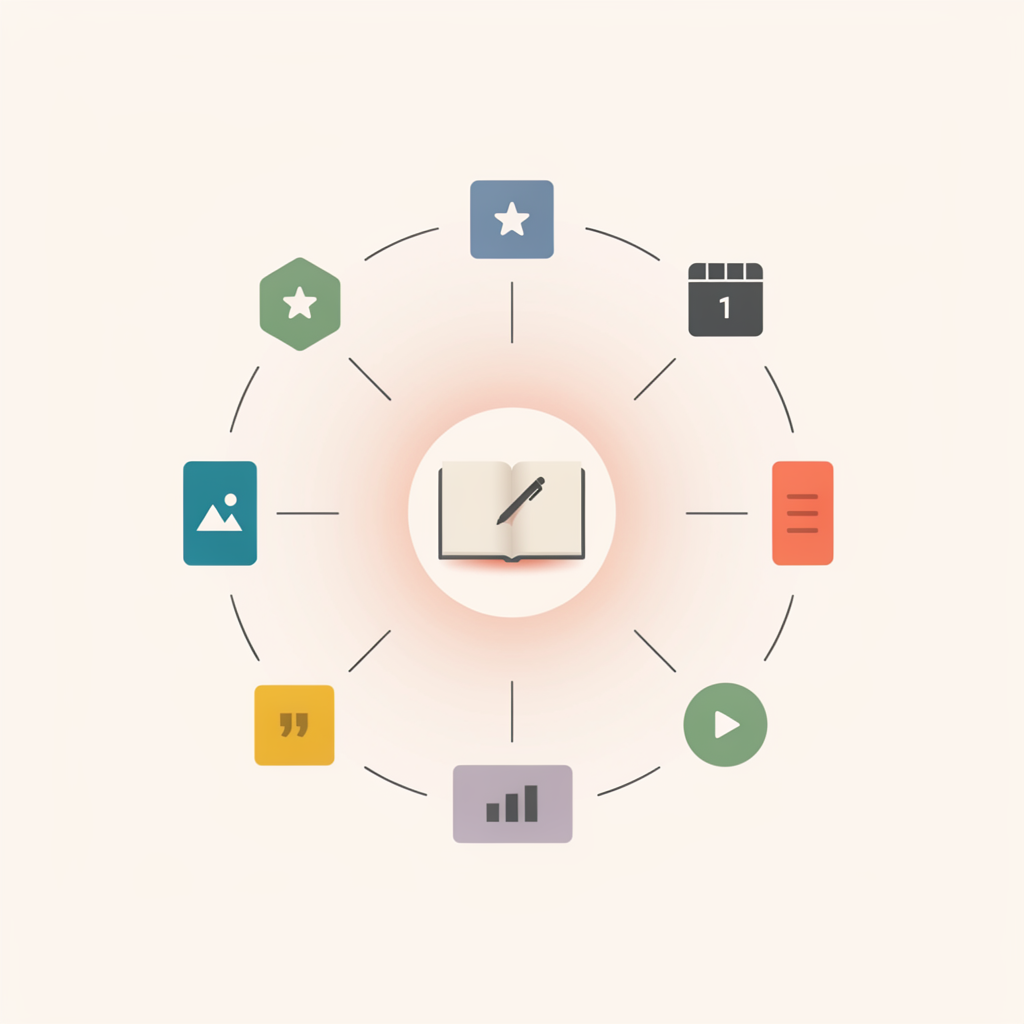
Think of it like a wheel. The pillar page is the center. Cluster pages are the spokes. Bidirectional links are the rim holding everything together.
HubSpot tested this structure back in 2017 and reported a 40% increase in organic traffic after reorganizing their existing content into topic clusters.
The difference between a blog hub and a blog is the same difference between a library with a catalog system and a box of loose papers.
What Are the Three Components Every Blog Hub Needs?
Every functional blog hub has a pillar page, a set of cluster pages, and bidirectional internal links connecting them.
The pillar page runs between 2,500 and 4,000 words and covers your main topic at a broad level. It answers the big questions without going so deep that readers get lost.
Then your cluster pages, usually between 5 and 20 depending on who you ask, handle the specific angles, questions, and use cases that your pillar page only touches on.
Ahrefs recommends building 5 to 20 subpages per pillar as a practical range. The third component, bidirectional linking, ties the whole structure together.
Each cluster page links to the pillar, and the pillar links to each cluster.
This creates a web of internal connections that tells both search engines and AI systems: these pages belong together, and together they represent deep coverage of one subject.
Why Do AI Engines Prefer Interlinked Pages over Standalone Posts?
AI engines like ChatGPT, Perplexity, and Google’s AI Overviews don’t just grab one page and call it a day. They run multiple retrieval passes when answering a question.
A standalone blog post gives them one chance to find you. A hub with 12 interlinked pages gives them 12 chances.
Each page can match a different sub-query the AI generates during its retrieval process.
The Yext research team analyzed 6.8 million AI citations and found that 86% of those citations came from websites with five or more interlinked pages on the cited topic.
That number should stop you in your tracks. If your content lives as isolated posts with no linking structure, you’re competing for the remaining 14% of citations.
The math is brutal for standalone content.
How Do Topic Clusters Earn 3.2x More AI Citations?
The same Yext study put a specific number on the advantage: sites organized into topic clusters earned 3.2 times more AI citations than sites with equivalent content published as standalone pages.
Why? Because AI retrieval systems weight topical authority.
When they find one page on your site that answers part of a query, they check whether your site has more pages on the same subject. If it does, they’re more likely to cite you.
This works because of how retrieval-augmented generation (RAG) systems operate. They don’t just match keywords. They evaluate whether a source has comprehensive coverage.
A single 3,000-word post might contain the same information as five 600-word cluster pages, but the cluster structure signals depth in a way that a single page cannot.
The AI system sees five separate confirmation points instead of one.
When Does a Blog Hub Make Sense for Your Business?
A blog hub makes sense when you have a core topic that your customers search for in multiple ways.
If people ask variations of the same question from different angles, that’s a hub waiting to happen. A local bakery probably doesn’t need one.
A SaaS company selling project management software absolutely does, because their customers search for task management, team collaboration, deadline tracking, Gantt charts, and dozens of related terms.
The investment is real. You’re committing to 8 to 15 pages of focused content, internal linking, and ongoing maintenance. But the payoff compounds.
Once your hub establishes topical authority, new cluster pages you add benefit from the existing structure immediately.
You’re building an asset that gets stronger over time rather than publishing disposable posts that decay within weeks.
Start by listing every question your customers ask about your core topic, then group those questions into clusters of related subtopics.