Lesson 1.1: Overview of Online Business
1. What Is an Online Business?
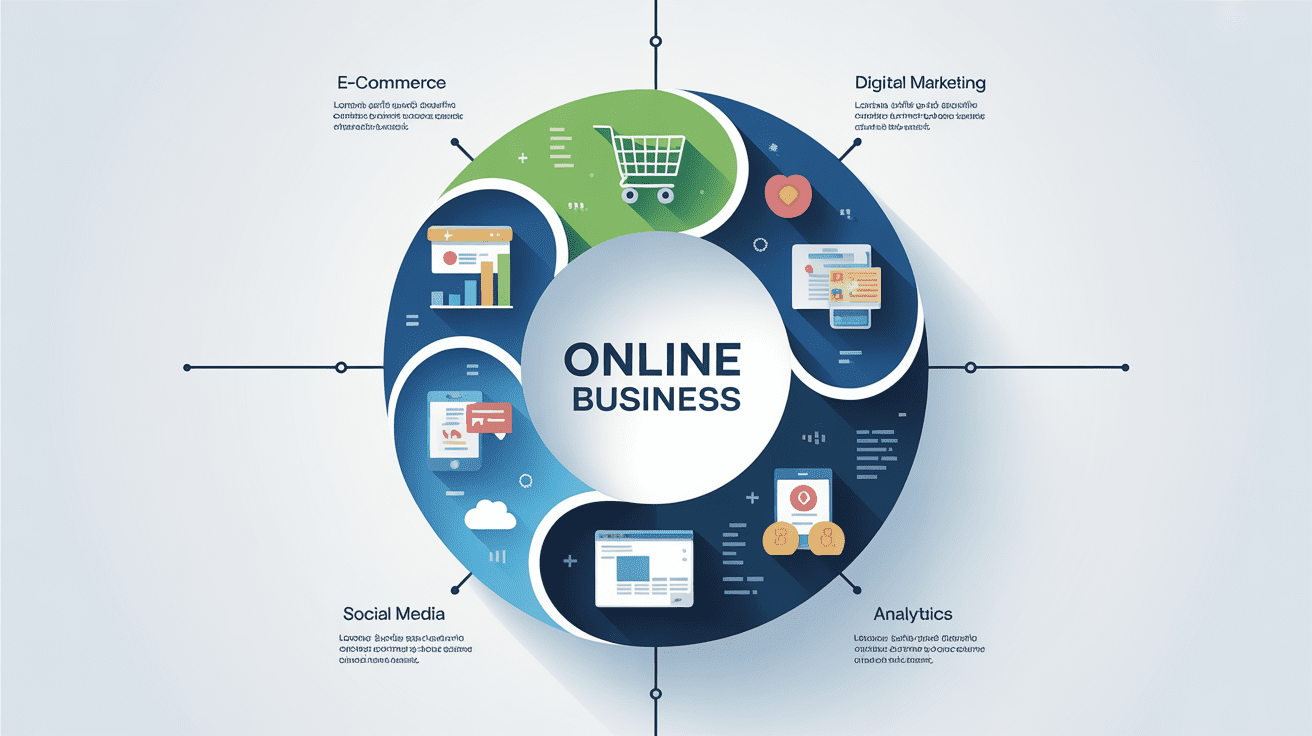
An online business is any commercial activity that delivers value, attracts customers, or generates revenue primarily through the internet.
While traditional businesses depend on physical presence, online businesses operate through digital platforms—websites, online marketplaces, social media, and automated systems.
In its simplest form:
An online business uses the internet to sell products, deliver services, or create income through digital interactions.
Online businesses can be completely virtual or blended with physical operations. Some rely heavily on automation; others require hands-on involvement.




Many can be started with little capital and scaled rapidly with the right systems.
2. Types of Online Businesses
Online businesses come in many forms. Below are the major categories you will encounter throughout this program:
1. E-Commerce Stores
Businesses that sell physical products online.
Examples: standalone Shopify stores, Amazon sellers, dropshipping stores.
Key features:
-
Product sourcing and inventory (or dropship fulfillment)
-
Online storefront and checkout
-
Shipping and logistics
2. Digital Products
Businesses that sell downloadable or access-based items.
Examples: eBooks, templates, online courses, digital art, software.
Key features:
-
No inventory or shipping
-
High margins
-
Can be automated and sold 24/7
3. Service-Based Online Businesses
Professionals offering skills remotely.
Examples: web designers, consultants, virtual assistants, coaches, social media managers.
Key features:
-
Time-for-expertise model
-
Can transition into agencies or digital products for scalability
4. Affiliate Marketing
Earning commissions by promoting other companies’ products or services.
Key features:
-
No product creation
-
Income grows with audience reach
-
Requires trust and consistent content
5. Content-Driven Businesses
Creators earn revenue through platforms, such as:
-
YouTube channels
-
Blogs
-
Podcasts
-
Newsletters
Revenue streams include: ads, sponsorships, affiliate income, paid subscriptions, and digital product sales.
6. Memberships and Community Platforms
Recurring revenue businesses offering exclusive content, training, or support.
Examples: learning communities, coaching memberships, private groups with premium content.
Key features:
-
Predictable monthly income
-
Requires ongoing engagement and content creation
7. Online Marketplaces & Platforms
Using platforms to facilitate transactions.
Examples: Airbnb hosts, Etsy sellers, stock photo contributors, app store developers.
Key features:
-
Built-in audience
-
Platform fees and rules apply
-
High competition but easier entry
3. Why People Choose Online Business (Benefits)
1. Low Startup Costs
Many online businesses can launch with little capital—sometimes under $100. No storefront, no lease, no large staff required.
2. Flexible Lifestyle
You control:
-
When you work
-
Where you work
-
How much you work
This appeals to people seeking independence or supplemental income without rigid schedules.
3. Scalability
Digital systems make it possible to grow quickly:
-
Automated sales funnels
-
Worldwide reach
-
Unlimited inventory for digital products
-
Outsourcing or AI-assisting operations
Your income is not limited to local customers or the hours in your day.
4. Access to Global Markets
Anyone with an internet connection can buy from you. This significantly increases your potential customer base compared to traditional local businesses.
5. Passive or Semi-Passive Income Potential
With digital products, automation, and AI tools, parts of your business can run even when you’re not actively working.
6. Immediate Feedback and Rapid Iteration
You can test ideas, messaging, pricing, and products in hours—not months.
Data and analytics allow you to make smart decisions quickly.
7. Unlimited Learning and Growth
Online entrepreneurship exposes you to marketing, branding, psychology, analytics, customer service, automation, and much more.
These skills apply everywhere.
4. Challenges of Running an Online Business
Online business is powerful—but not effortless. Awareness of common challenges helps you prepare and succeed.
1. High Competition
Because the barriers to entry are low, many niches are crowded.
What wins today: positioning, authority, clear value, consistency, and branding.
2. Learning Curve
You may need to learn about:
-
Website setup
-
Basic tech tools
-
Online marketing
-
Funnels and lead generation
-
Analytics
-
Branding & content strategy
These skills are learnable but require time.
3. Consistent Output Is Required
Online businesses thrive on momentum.
You need consistent:
-
Content
-
Marketing
-
Customer engagement
Many people quit too early because they underestimate this.
4. Income Can Be Unpredictable at First
It takes time to build:
-
An audience
-
Trust
-
Funnels
-
Repeatable revenue
-
Systems that scale
Expect your early months to feel uneven. This is normal.
5. Staying Focused Amid Endless Options
The online world offers many opportunities—too many, in fact.
Shiny-object syndrome is one of the biggest reasons people fail.
6. Tech Issues
From website bugs to payment processor problems, tech challenges are part of the ecosystem.
The good news: most can be solved quickly with tools, tutorials, or support teams.
7. Building Trust Takes Time
Online customers are skeptical.
They need:
-
Proof
-
Clarity
-
Transparency
-
Consistency
-
Demonstrated value
Trust is earned through authentic communication and reliable delivery.
5. Key Takeaways from Lesson 1.1
-
Online business means creating value and earning revenue through digital channels.
-
There are several types of online businesses—products, services, content, communities, and marketplaces.
-
Benefits include low costs, flexibility, scalability, and global reach.
-
Challenges include competition, learning curves, early income instability, and the need for consistency.
-
Success comes from clarity, systems, and focused execution—not from doing everything at once.
Lesson 1.1 – Worksheet: Overview of Online Business
Part 1: Reflection Questions
1. In your own words, what is an online business?
Write 2–3 sentences.
2. Which type of online business interests you the most right now? Why?
(Choose from: e-commerce, digital products, services, affiliate marketing, content creation, memberships, online marketplaces)
3. What skills or strengths do you already have that could support an online business?
(Examples: writing, tech, design, marketing, coaching, sales, organization)
4. What skills do you feel you need to build or strengthen before starting?
5. What excites you most about the idea of running an online business?
6. Which potential challenge feels most real to you right now—and why?
(Examples: tech learning curve, competition, consistency, time commitment)
Part 2: Matching Activity – Types of Online Businesses
Match each business type to its description.
Write the correct letter beside each number.
Business Types
A. E-commerce
B. Digital Products
C. Services
D. Affiliate Marketing
E. Content Creation
F. Memberships
G. Online Marketplaces
Descriptions
-
___ Selling physical items through an online storefront.
-
___ Earning commissions by promoting someone else’s product.
-
___ Creating content like videos, articles, or podcasts to generate revenue.
-
___ Selling downloadable or access-based items like templates or courses.
-
___ Using platforms like Etsy, Airbnb, or app stores to reach customers.
-
___ Offering skills like consulting, design, coaching, or virtual assistance.
-
___ A recurring-revenue model offering ongoing value in a private community.
Part 3: Benefits vs. Challenges
List three benefits and three challenges of running an online business.
Benefits
Challenges
Part 4: Your Starting Point
Based on what you’ve learned, what type of online business would you MOST likely start today—and why?
Write a paragraph:
Lesson 1.1 – Short Quiz
Circle or select the best answer.
1. Which statement best describes an online business?
A. A business that operates only from a physical location.
B. A business that uses the internet as its main method of creating value and generating revenue.
C. A business that must sell digital products only.
D. A business that requires a large team to operate.
2. Which of the following is an example of a digital product?
A. Custom-printed T-shirt
B. Online course
C. Catering service
D. Car rental
3. What is one major benefit of running an online business?
A. Guaranteed immediate income
B. Zero competition
C. Low startup costs
D. No need for marketing
4. Which challenge is common for new online entrepreneurs?
A. Too few online platforms
B. High initial fixed costs
C. Building trust with customers
D. Limited access to global markets
5. Membership-based businesses are defined by:
A. One-time product sales
B. Recurring revenue for exclusive ongoing value
C. Buying products wholesale
D. Offering only physical goods
Answer Key
-
B
-
B
-
C
-
C
-
B
Related Posts: