HOW TO EXTEND YOUR BLOG HUB OFF-SITE WITH REDDIT, YOUTUBE, AND LINKEDIN
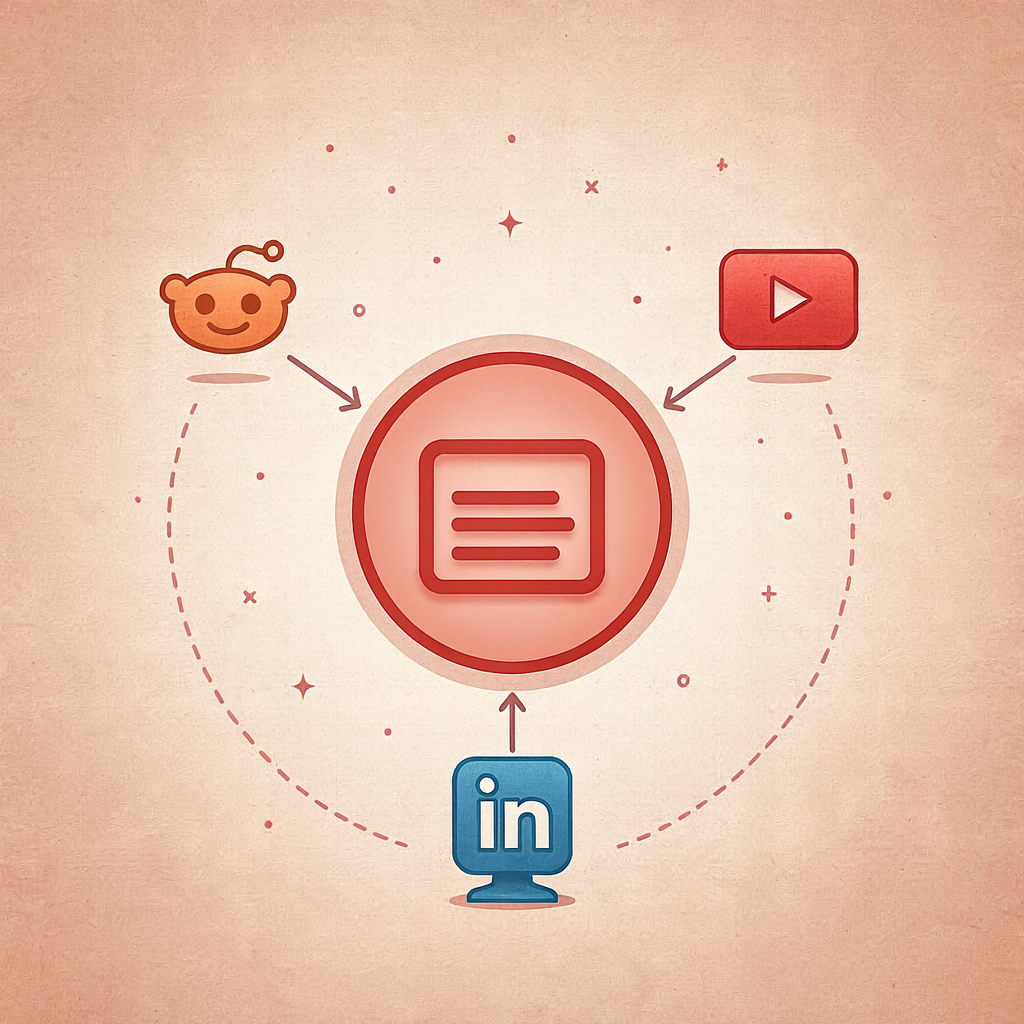
A blog hub that exists only on your domain misses the fact that AI engines pull citations from across the web, and three platforms dominate off-site AI citations: Reddit, YouTube, and LinkedIn.
Why is a hub that stays on your domain incomplete?
Think about how ChatGPT or Perplexity assembles an answer. It doesn’t just scan one website.
It pulls from dozens of sources across the open web, ranking them by recency, specificity, and how often a brand name appears alongside a topic.
If your brand only shows up on yoursite.com, the AI has one data point.
That’s weak signal compared to a competitor whose name appears on Reddit threads, YouTube transcripts, LinkedIn articles, and partner blogs simultaneously.
HubSpot credits hundreds of partner publications for their citation lift in AI answers. They didn’t just publish great content on their own domain.
They made sure their name, frameworks, and data showed up everywhere buyers ask questions. Your blog hub needs the same strategy, even at a smaller scale.
One domain equals one vote. Five platforms equals five votes for the same topic.
How does Reddit earn a 46.5% citation rate in Perplexity?
Perplexity cites Reddit in 46.5% of its responses. Read that number again. Almost half the time someone asks Perplexity a question, a Reddit thread ends up in the answer.
Google AI Overviews cite Reddit in 21% of responses too. The Tinuiti Q1 2026 report found Reddit’s citation share grew over 73% across commercial categories in the past year alone.
This isn’t a fluke. Reddit threads read like real human conversation, and AI engines trust that signal.
So what does this mean for your hub? You need to be active in subreddits where your buyers hang out. Answer questions thoroughly.
Reference your own research or data when relevant, but do it in a way that helps the thread. Don’t drop links and run.
Write the kind of answer that gets upvoted because it actually solves the problem. When AI engines crawl that thread next week, your brand name sits right next to the topic you want to own.
Why is YouTube the top-cited domain in Google AI Overviews?
Ahrefs Brand Radar data shows YouTube grew 34% as a cited domain over a six-month period in AI Overviews. The number-one category for YouTube AI citations is instructional and how-to content.
That makes sense. When someone asks an AI how to do something, a video with clear steps and a transcript is gold.
The AI can read the transcript, verify it matches the query, and cite it with confidence.
You don’t need a production studio. A screen recording with voiceover that walks through your process works fine. Title it with the exact question your buyer asks.
Include a detailed description with timestamps and key terms. Upload a transcript if YouTube’s auto-captions miss technical words.
Each video becomes another node in your hub that exists off your domain but still builds your brand’s authority on the topic.
How does brand co-occurrence across platforms build AI authority?
Brand co-occurrence means your brand name appears alongside a specific topic across enough pages, formats, and surfaces that AI engines start to associate the two.
It’s the off-site version of entity density.
If “Acme Analytics” appears next to “ecommerce conversion tracking” on your blog, in a Reddit answer, in a YouTube video description, and in a LinkedIn article, that pattern tells the AI something.
It says this brand is relevant to this topic, confirmed by multiple independent sources.
The practical approach is straightforward. Pick your core topic. Then make sure your brand name appears alongside that topic on at least four different platforms within a 90-day window.
LinkedIn articles work well for B2B thought leadership because they get indexed quickly and carry professional authority signals.
Combine that with Reddit participation and YouTube content, and you’ve built a web of co-occurrence that no single-domain strategy can match.
What is the AI slop loop and how do you avoid it?
Lily Ray coined the term “AI Slop Loop” to describe what happens when brands use AI to mass-produce generic content, publish it everywhere, and then AI engines refuse to cite it because it contains no original information.
The content reads like everything else because it was generated from the same training data. There’s no new insight, no original research, no real expertise.
Cyrus Shepard documented cases where sites received spam manual actions from Google after publishing off-topic AI-generated articles at scale.
The fix is simple in concept, harder in execution. Use AI as a writing assistant, not the author. Add original data from your own business.
Include case studies with real numbers. Quote actual experts by name. When you post on Reddit, write from genuine experience.
When you record a YouTube video, share something you learned firsthand. The off-site extension of your hub only works if each piece carries information that didn’t exist before you created it.
That’s what earns citations. That’s what breaks the slop loop.
Start with one Reddit subreddit and one YouTube how-to video this week, then layer in LinkedIn once you’ve found your rhythm on the first two platforms.