
HOW TO BUILD A BLOG HUB FOR AEO
The content architecture that makes AI engines recommend your business
You already know something is off
You published the blog posts. You followed the keyword research. You even hired a writer for a few months. And yet when you ask ChatGPT or Perplexity about your industry, your business never comes up. Your competitor does. A company with half your experience and a worse product gets named by the AI, and you get nothing.
You check your Google Analytics and the traffic numbers look fine. Maybe even good. But the phone isn’t ringing the way it used to. The leads feel thinner. Something shifted in how people find businesses, and your content strategy didn’t shift with it.
If you’ve watched your carefully written blog posts sit there doing nothing while AI engines recommend someone else, you are not alone. The rules changed in 2025, and most businesses are still playing by the 2019 playbook.




The Problem is not Your Content. The Problem is Your Structure.
Here’s what happened: AI engines don’t work like Google used to. When someone asks ChatGPT a question, it doesn’t just match keywords. It breaks that question into 5-15 sub-queries, retrieves web pages for each one separately, scores the passages, and builds a single answer from the best matches it finds.
One blog post on a topic gives you one chance to be retrieved. One raffle ticket in a drawing with thousands of entries. A competitor with twelve interlinked pages covering different angles of the same topic has twelve tickets. That’s not a content quality problem. It’s an architecture problem.
How to Build a Blog Hub for AEO is the fix. It’s a 13-chapter implementation guide that shows you exactly how to build the content structure that makes AI engines retrieve, cite, and recommend your business.
The method is called a blog hub, and it works like this:
✓ One pillar page covers your main topic at the overview level and links to everything else.
✓ 8-15 cluster pages each answer one specific question your buyers ask, written so the AI can extract and cite them.
✓ Bidirectional internal links wire everything together so AI engines understand you own the topic.
✓ Answer-first writing puts your most citable content where the AI actually looks (the top of the page, not buried in paragraph five).
Sites with topic clusters earn 3.2x more AI citations than single-page competitors. 86% of citations come from sites with five or more interlinked pages.
What’s Inside
The guide covers everything from the research proving blog hubs work, to choosing your topic, to writing content the AI extracts, to platform-specific setup instructions. Here’s the chapter breakdown:
|
Chapters 1-2: Why Blog Hubs work and how AI engines use them |
| What you walk away with: The data from Yext (6.8M citations), AirOps (815K query-page pairs), and Kevin Indig (1.2M ChatGPT responses) proving that interlinked content earns dramatically more AI citations. Plus the mechanical explanation of query fan-out, the raffle ticket model, and the ski-ramp effect. |
|
Chapter 3: Anatomy of a blog hub that actually works |
| What you walk away with: Exact sizing benchmarks (how many pages, how many words), internal linking rules with specific placement guidance, and why the old 8,000-word skyscraper pillar stopped working. |
|
Chapter 4: Planning your hub with topic research and cluster mapping |
| What you walk away with: The spreadsheet method for mapping your entire hub before writing a word. Choosing topics, mining subtopics with AI tools, and avoiding keyword cannibalization. |
|
Chapter 5: Writing content that AI engines extract and cite |
| What you walk away with: Answer-first structure, front-loading facts in the first 200 words, question-style headings, entity density targets (15-20% proper nouns), and credential signals. |
|
Chapters 6-9: Business-type blueprints |
| What you walk away with: Specific hub architectures for ecommerce, digital product stores, education/courses, and B2B SaaS. Real case studies from REI, Casper, Glossier, HubSpot, and others with actual revenue numbers. |
|
Chapters 10-11: Edge cases and technical setup |
| What you walk away with: Where hubs don’t work (and what to do instead), plus WordPress, Shopify, Squarespace, and Wix implementation with schema markup guidance. |
|
Chapters 12-13: Off-site extension, measurement, and scaling |
| What you walk away with: How to extend your hub to Reddit, YouTube, and partner publications. Dual-track measurement for organic and AI visibility. The 90-day build plan. |
Who This is For
This guide works for anyone selling products or services online who wants AI engines to recommend them. Specifically:
✓ You run an ecommerce store and your product pages never show up in AI-generated recommendations, even though you have great reviews.
✓ You sell digital products like templates, courses, or prompt packs, and you rely on marketplace traffic that could disappear tomorrow.
✓ You run a B2B SaaS or service business and your buyers spend weeks researching before they commit. You want to be in front of them the entire time.
✓ You’re a course creator or educator and you want to be the name AI engines mention when someone asks how to learn your subject.
✓ You’ve heard of AEO but don’t know where to start and you want a concrete plan instead of another vague strategy article.
What Makes this Different
This is not a theory book. There are no chapters explaining the history of content marketing or speculating about what might work someday. Every recommendation in this guide is backed by studies published in 2025 and 2026, from organizations that analyzed millions of real AI citations.
You won’t find vague advice like “create great content.” You’ll find specific numbers: how many pages to write (8-15 cluster pages per hub), how long each should be (1,200-1,800 words for clusters), where to put your key facts (first 200 words), and what heading format gets cited most (question-style, which correlates with 78.4% of citation-bearing answers).
This is the companion to Make ChatGPT Promote Your Business. The first book taught you what signals AI engines look for. This book shows you how to build the machine that generates those signals at scale.
What You Get
| You Get | What It Means for You |
| 13-chapter implementation guide | Step-by-step from planning to publishing, with nothing left out |
| Business-type blueprints | Specific architectures for ecommerce, digital products, courses, and SaaS |
| Research-backed sizing benchmarks | Exact page counts, word counts, and link placements that correlate with citations |
| Real case studies with revenue numbers | REI, Casper, Glossier, HubSpot, Land of Rugs, and more |
| Cluster map spreadsheet method | A planning tool so you can map your entire hub before writing |
| Platform setup instructions | WordPress, Shopify, Squarespace, Wix, Kajabi, and others |
| 90-day build plan | A week-by-week timeline so you know exactly what to do and when |
What Readers are Saying
“I had 47 blog posts published over three years and none of them were getting cited by AI. After reading this guide, I restructured 12 of them into a hub with a new pillar page. Within six weeks, ChatGPT started mentioning my brand for three different buyer questions. That never happened with scattered posts.”
— Sarah K., ecommerce store owner (home organization products)
“The cluster map spreadsheet method saved me from writing five articles that would have competed with each other. I built my first hub in about two months following the 90-day plan, and my Perplexity citations went from zero to consistent within the first quarter.”
— Marcus D., B2B SaaS founder (project management software)
“I sell Canva templates on Etsy and Shopify. This guide convinced me to build a tutorial blog on my own domain instead of just relying on marketplace traffic. The tutorial-with-tool format from Chapter 7 was exactly what I needed. My organic traffic tripled in four months and I’m getting direct sales I never got before.”
— Jenna T., digital product creator
Zero Risk. All Reward.
If this guide doesn’t give you a clear, actionable plan for building a blog hub that gets your business cited by AI engines, you get your money back. No hoops, no justification required.
The research in this guide is publicly verifiable. The methods are specific and measurable. Either they work for your business or they don’t, and you’ll know within 90 days of implementing.
Get Started Today
How to Build a Blog Hub for AEO
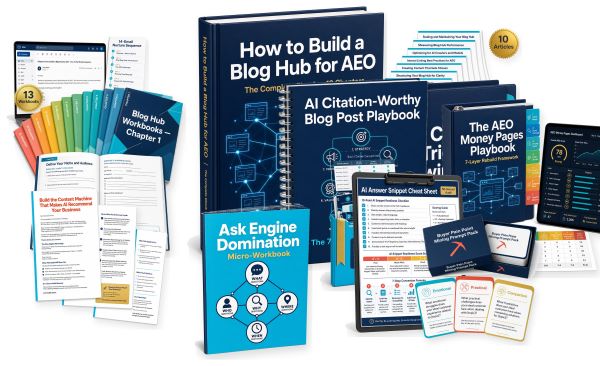
The definitive guide to making AI engines recommend your business
Only $19.95
Instant download. Works with any website platform.
P.S.
Every day you don’t have a blog hub is another day the AI engines recommend someone else for questions your buyers are asking right now. Yext’s research on 6.8 million citations is clear: 86% of AI citations go to sites with five or more interlinked pages on a topic.
This guide gives you the architecture, the writing method, the platform setup, and the 90-day plan. Everything you need to stop being invisible to AI search and start being the business that gets recommended.
Grab your copy now.